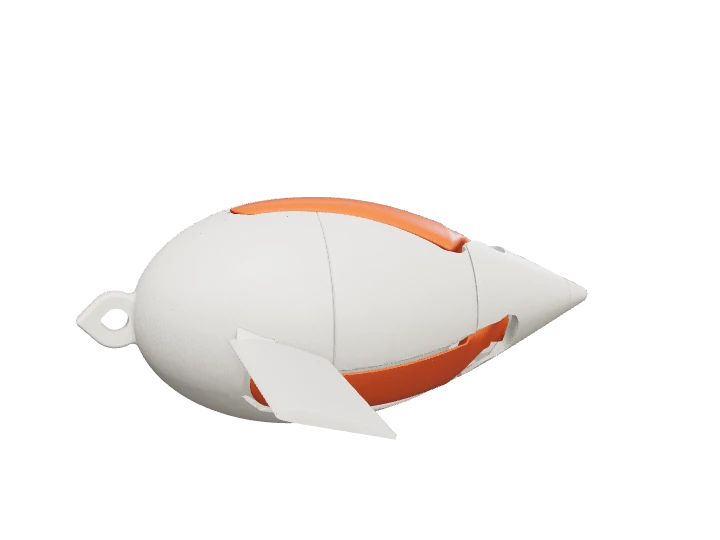
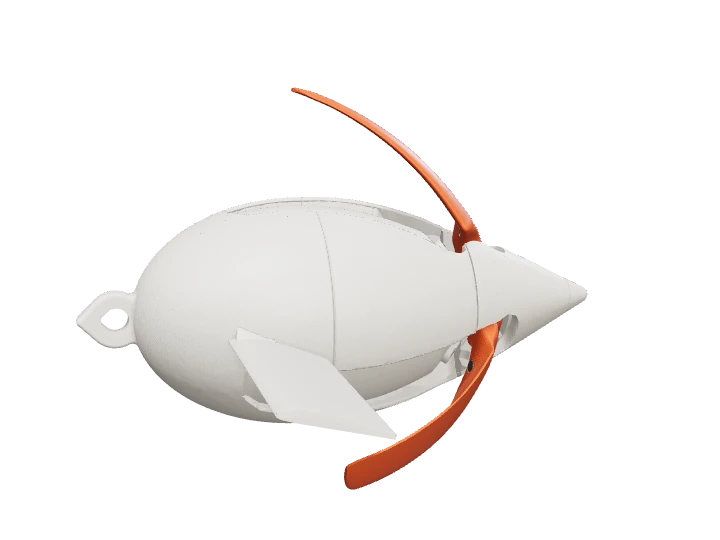
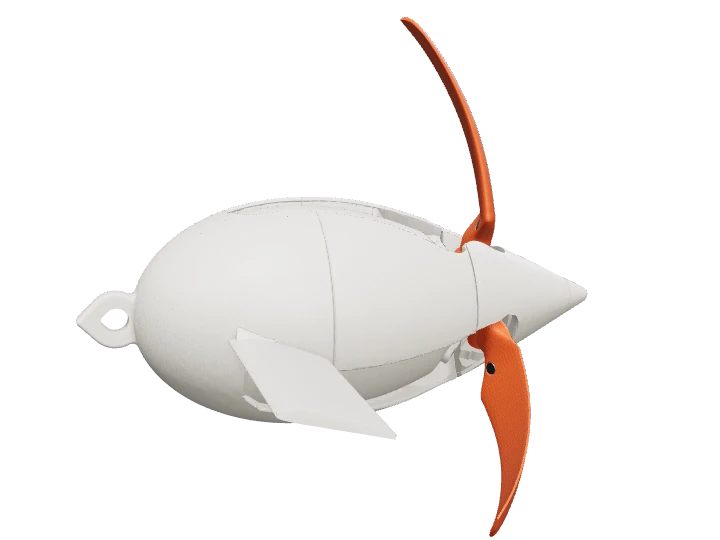
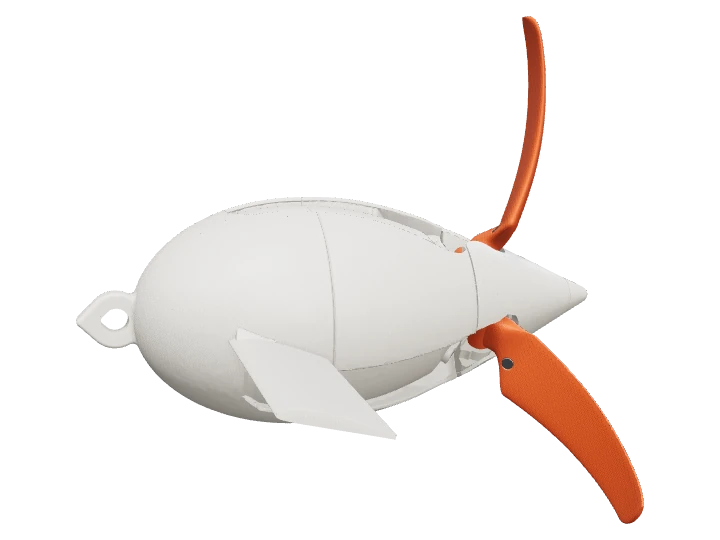
Ovo is a generic portable hydrokinetic charger: an axial turbine you tether in a stream or tow behind a boat. The hull is a Myring body of revolution shaped like an egg. The rotor sits downstream at the tail, and its three blades fold forward into shallow pockets, so the packed product is a clean egg with three orange stripes.
This first version is a display build with real mechanics. The rotor turns on two ball bearings and the blades really fold, held by magnets at both ends of their travel. The generator bay carries a printed replica of the motor chosen for v2, with its real envelope and bolt patterns. The shaft seal pocket, the O-ring gland at the equator and the cable gland seat are modelled too, so v2 can add electronics without a redesign.
Every dimension lives in one Python file, ovo/params.py. The design studies write JSON that the CAD reads, and one command rebuilds every part, runs the checks and exports the STL and STEP files and the model at the top of this page.
- Hull
- Myring profile, Ø75 mm, built length 161 mm, L/D 2.15, 2.4 mm wall
- Rotor
- 3 blades, Ø194 mm, downstream, tangential hinge pins at r 14 mm
- Blades
- NACA 44xx, t/c 18 to 12 %, chord 25.1 mm to 14 mm, twist 17.2° to 5.2°, 0.6 mm trailing edge
- Design point
- 1.5 m/s current at TSR 4; towing at 2 to 2.5 m/s
- Drivetrain
- 8 mm stainless shaft on 608-2RS and 688-2RS bearings, thrust collar, dog coupling, lip seal pocket for v2
- Joint
- Split at the equator: 3-lug bayonet with click tines, AS568-141 O-ring gland for v2
- Roll fins
- 2 slide-in Clark Y fins, 30 × 70 mm, 12.5° incidence, on recessed rails with flush blanking strips
- Generator
- Bay for a CubeMars GL40 KV70 in v2; a printed replica in v1
- Printer
- Bambu Lab A1, P1S or X1 (256 mm bed), PLA and PETG, one material per plate
- CAD
- build123d (Python, OpenCascade), one module per subassembly